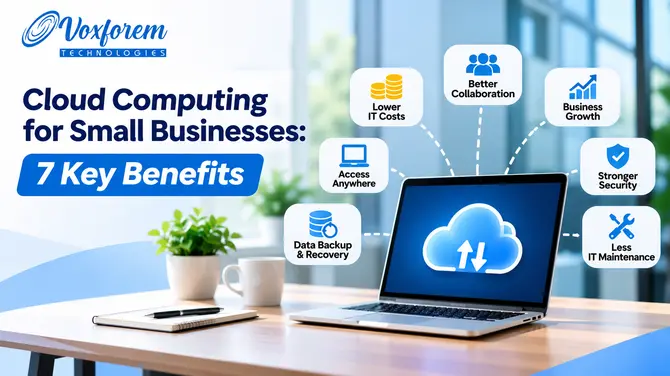
Cloud Computing for Small Businesses: 7 Key Benefits
Cloud computing is changing how businesses store information, manage applications, and work with customers. Instead of depending entirely on physical computers and office servers, businesses can use cloud-based services to access software, files, and business data through the internet.
For small businesses, cloud computing offers a practical way to improve productivity, reduce IT responsibilities, and support business growth.
In this article, we explore seven important benefits of cloud computing and how businesses can use it effectively.
What Is Cloud Computing?
Cloud computing allows businesses to use computing resources such as storage, software, databases, and servers over the internet.
Instead of installing and maintaining every system locally, businesses can access services provided by cloud platforms.
For example, employees can access business documents from different locations, collaborate on projects, and use online applications without depending on a single office computer.
Cloud computing can support businesses of different sizes, from startups to established companies.
7 Benefits of Cloud Computing for Small Businesses
1. Reduce IT Costs
Traditional IT systems require businesses to purchase computers, servers, storage devices, and other equipment. Cloud computing allows businesses to use services without investing heavily in their own infrastructure.
Many cloud services offer subscription-based pricing, allowing businesses to pay for the resources they need. This can help reduce initial costs and make technology more accessible to small businesses.
However, businesses should review subscription fees, storage usage, and additional service costs before choosing a provider.
2. Access Business Data from Anywhere
Cloud computing allows employees to access authorised business information through an internet connection. This is useful for businesses with remote employees, multiple offices, or teams working outside the workplace.
For example, a sales employee can access customer information while visiting a client, while a manager can review business reports from another location.
Businesses should use secure login methods and appropriate access permissions to protect their information.
3. Improve Team Collaboration
Cloud-based applications allow employees to work together using shared documents, calendars, communication tools, and project management systems.
Team members can access updated information without repeatedly sending files through email. This improves communication and helps reduce confusion caused by multiple versions of the same document.
Cloud collaboration is particularly useful for businesses managing different departments or remote teams.
4. Support Business Growth
As businesses grow, their technology requirements also increase. They may need additional storage, more user accounts, better applications, or additional computing resources.
Cloud services allow businesses to increase or reduce resources based on their requirements. This flexibility helps companies respond to changing business needs without immediately purchasing additional physical equipment.
5. Improve Data Backup and Recovery
Business data is important for daily operations. Losing customer information, financial records, or business documents can interrupt operations and create financial risks.
Cloud services can support automated backups and data recovery options. Businesses should choose suitable backup schedules, understand recovery procedures, and maintain copies of important information.
Cloud storage alone does not guarantee complete protection. Proper backup policies and security practices are still necessary.
6. Strengthen Business Security
Many cloud providers offer security features such as encryption, access controls, monitoring, and multi-factor authentication. These features can help businesses protect information and manage access to their systems.
However, security also depends on how businesses configure and use their cloud services. Employees should use strong passwords, avoid sharing login credentials, and ensure that only authorised people can access sensitive information.
Businesses should also review their provider's security policies and data protection practices.
7. Reduce IT Maintenance
Managing physical servers and IT infrastructure requires regular maintenance, updates, monitoring, and troubleshooting.
Cloud computing can reduce some of these responsibilities because the provider manages parts of the underlying infrastructure. This allows businesses to spend more time on operations, customers, and growth.
The level of maintenance depends on the type of cloud service selected. Businesses using cloud applications may have fewer infrastructure responsibilities than those managing their own cloud servers.
How to Choose the Right Cloud Solution
Before moving business operations to the cloud, companies should consider their requirements.
- Identify business needs: Determine whether the business needs cloud storage, accounting software, collaboration tools, hosting, or complete infrastructure services.
- Review security: Check authentication options, access controls, backup policies, and data protection practices.
- Compare costs: Understand subscription fees, storage limits, usage charges, and possible additional expenses.
- Check compatibility: Ensure the cloud service works with existing business applications and workflows.
- Plan the migration: Move important information carefully and test systems before fully switching to cloud services.
Starting with one business process can help companies understand the benefits and challenges before expanding their cloud usage.
Conclusion
Cloud computing helps small businesses improve collaboration, access information remotely, reduce infrastructure costs, and support growth. It also provides opportunities to improve backup practices, simplify IT maintenance, and use modern business applications.
The right cloud solution depends on business requirements, security needs, budget, and existing systems. By planning carefully and selecting suitable services, businesses can use cloud computing to improve efficiency and build a more flexible technology environment.
Looking for technology solutions for your business? Voxforem provides software development and digital solutions to help businesses improve their operations. Explore Voxforem to learn more about its services.